
The first anchor was forged in Söderfors in 1676. In 2026 the ironworks turns 350 — and unlike almost every other Walloon forge in northern Uppland, it is still working. This is the short version of a long story: the rapids, the anchors, the park, the steel, and the people who stayed.
The 1600s — anchors for the navy
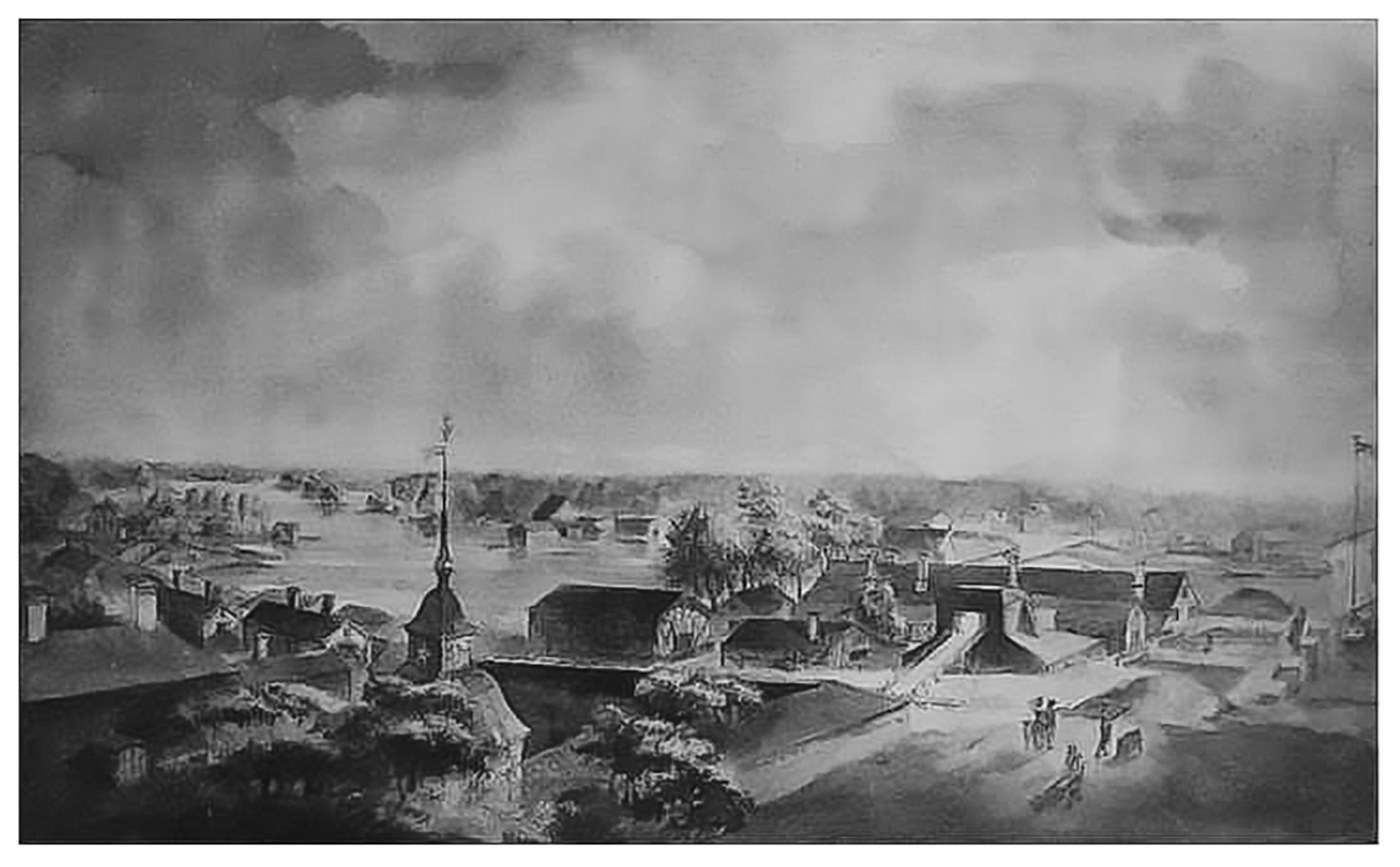
At Älvkarleby, the mining inspector Claes Depken had worked out how anchors could be forged with a water-driven hammer instead of by hand with sledgehammers. He needed rapids strong enough to drive that hammer all year round. On 29 April 1676 the Crown issued the charter permitting Claes Depken Anckarström to build an anchor works at Söderfors — on the spot where Erasteel stands on Storgatan today. The anchors went to the navy — that was the whole reason the place existed, and Depken was in time ennobled under the name Anckarström.
In 1685, after a good deal of litigation, the works passed to Johan Leijoncrona of Untra. A forge that makes nothing but anchors depends on war, and so that Söderfors could survive peacetime it was later granted the right to make bar iron as well. That is where the second story begins — the one about steel.
The 1700s — the Grills, the park and the temple
In 1748 Söderfors was bought by Claes Grill, a director of the Swedish East India Company, and his wife Anna Johanna Grill. The Grill family would own the works until 1907, and it is their century that is still most visible as you walk through the village.
The manor house, built around 1690, was remodelled in rococo between 1749 and 1756 under Carl Hårleman and took on essentially the appearance it has today. In 1752 the day-work bell went up on Storgatan — the bell that announced when the working day began and ended. In 1776 Anna Johanna Grill had Änkehuset, the widows’ house, built down by the riverbank: a two-storey building of slag stone where widows of the works’ labourers, and single women with children, were given somewhere to live. It served that purpose until 1916. Along the streets stood the rows of whitewashed smiths’ cottages, built in the later 1700s to a new plan for the whole works area.
In 1784 Adolf Ulric Grill and his wife Anna Johanna Grill began laying out an English landscape park beside the works, using ideas gathered on their travels in England. When the harvests failed in the surrounding parishes in the early 1790s, Grill pushed the work forward — not chiefly for the park’s sake, but to give those in need a way to earn their bread. Locally it came to be known as “the Hedesunda loaf”. In 1795 a Greek temple modelled on the Theseion in Athens was raised at the heart of the park; it was completed in 1797 and still gives the park its character. In the same period, between 1789 and 1792, Söderfors church was built to Erik Palmstedt’s drawings after the old cruciform church burned down.
The 1800s — from anchors to steel
Early in the 1800s the Söderfors monopoly on anchor forging was abolished, and anchor production was wound down by degrees. By the end of the century only smaller anchors and grapnels were being made. In its place a modern industry grew up alongside — blast furnace, rolling mill, open-hearth plant and steel forge. In 1872 the Grill family formed Söderfors Bruks AB, and two years later the branch line to Orrskog opened: nine kilometres of track tying Söderfors to the main line between Uppsala and Gävle.
In 1876 the works turned 200. Two large anchors were raised in the English park to commemorate the anchor-making years. They are still standing — Söderfors has marked its own anniversaries before.
The 1900s — high-grade steel
In 1907 Stora Kopparbergs Bergslags AB bought the works and moved its quality-steel production here from Domnarvet. That became the Söderfors speciality: stainless steel, high-speed steel and cemented carbide — products where making a great deal of something is not enough, you have to make it exactly. Then came the century of changing owners: Uddeholm in 1976, Kloster Speedsteel in 1982, Erasteel Kloster in 1992, and in the mid-1990s the eastern works was sold on to what is now Alleima Söderfors.
In 1973 the Söderfors rural district was absorbed into Tierp Municipality. In 1985 large parts of the then 300-year-old ironworks were listed as a protected historic building — at that point the largest such listing in Sweden. Änkehuset followed in 1995 and the English park in 1998. Over the same period the railway fell silent: passenger services ended in 1962, freight in 1989, and the rails were lifted in 1993. The station building is still there, and is now a restaurant.
Today — the works is still working
Söderfors is one of many Walloon ironworks in northern Uppland, and the only one still operating on any real scale. That is the actual point of a 350th anniversary here: this is not a museum to something that ended. Steel is made here now, this year.
The village has shrunk since the industrial decades — from a peak of around 2,855 residents in 1970 to 1,646 at the end of 2023. But the works street is still lined with its smiths’ cottages, the 1690 manor house takes guests as a hotel and restaurant, the temple stands in the park, and the local heritage society keeps Änkehuset and Gammelgården open. Three hundred and fifty years is a long time for a place to hold together. Söderfors has managed it.
Celebrate with us on Söderforsdagen
On Saturday 5 September 2026, local businesses, societies and hobby groups gather at Bruksvallen between 1pm and 4pm. This year the day carries some extra historical weight — it is the 350-year-old that is being celebrated.
The anniversary poster
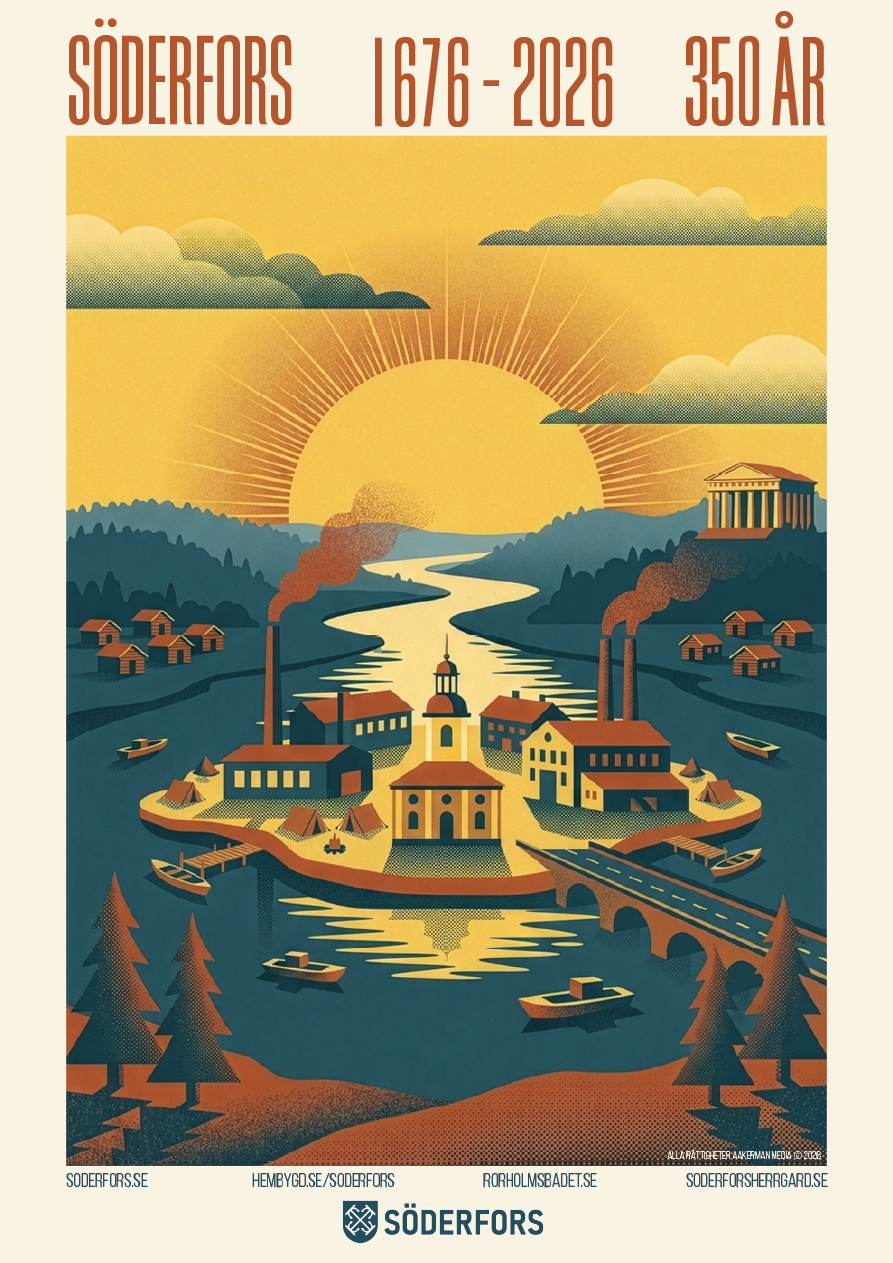
For the 350th anniversary, Aakerman Media has designed a poster that gathers the whole place into one image: the river running through the village, the works with its chimneys, the church, the Greek temple up on the ridge and the houses along the water. Along the bottom stand the ones who keep Söderfors alive — the heritage society, Rörholmsbadet, the manor house and this site.
The poster is the face of the anniversary year here on Söderfors.se. A 350th deserves an image of its own — and somewhere the year’s events are gathered and kept.
See the history for yourself
Änkehuset, the English park with its Greek temple, the anchor forge, Gammelgården, the church and Untraverket — all of them can be visited. Here is the full collection of historic places in the area.